Kerala: CPI(M) Turns to Hindutva After the Electoral Rout
There is an even deeper contradiction.
Total Views |


“Religion is the opium of the people.” Marx’s famous formulation was never merely a casual observation. It expressed the Marxist understanding of religion as a force that could obscure material contradictions and sustain existing social relations. For generations, Indian communists inherited this ideological suspicion of religion. And among the religious traditions they found particularly difficult to accommodate was Hinduism.
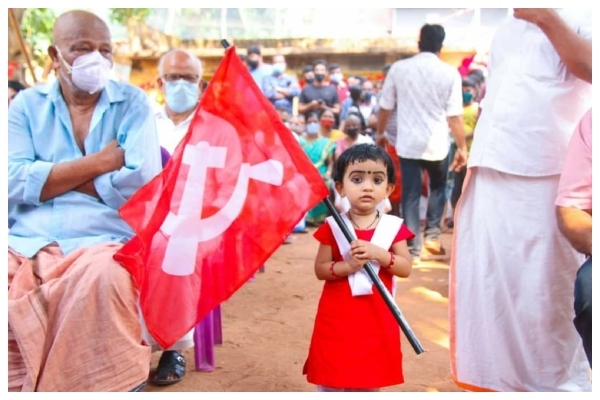
Now Kerala’s CPI(M) is discovering a rather uncomfortable political truth: the people whom it once expected to educate out of religious consciousness have not disappeared. They are still there and they still celebrate their festivals.
After the 2026 electoral debacle, the party has begun what it calls “fearless” discussions, taking its organisational introspection to the grassroots. The exercise is meant to identify why a government that had completed two consecutive terms was decisively rejected.
But perhaps one question needs to be asked more fearlessly than others - Has the CPI(M) lost touch with the cultural life of Hindu Kerala?
The question becomes unavoidable when Hindu festivals, temples and rituals are no longer confined to private religious life but remain an integral part of Kerala’s social landscape. Onam, Vishu, Thrissur Pooram, Attukal Pongala, temple festivals, Theyyam and countless local celebrations are not marginal activities. They are woven into Kerala’s cultural identity.
ALSO READ: Cong hates development? Three CMs of grand old party skips BRICS Meet for petty reason
And the ballot box has delivered a warning.
The LDF’s vote share collapsed from 44.44 percent in 2021 to 37.44 per cent in 2026. Its Assembly tally crashed from 99 seats to just 35. The UDF rose from 40 to 102. The BJP won three seats, having won none in 2021.
The CPI(M)’s own vote share tells an even more revealing story. Its 2026 Assembly vote share was about 21.77 per cent, down from 25.38 per cent in 2021.
The Hindu vote was an important part of this story. One post-poll assessment found that the Hindu vote, traditionally providing the Left with a counterweight to the UDF’s minority support, fragmented in 2026, with the BJP-led NDA drawing a portion of the Hindu vote while the UDF also retained substantial support among Hindu communities.
That is the political context in which the CPI(M)’s newfound interest in Hindu cultural institutions becomes significant.
If the party now discovers that temple committees matter, that Hindu festivals matter, that devotees matter and that cultural sentiments matter, it must confront an obvious question: why did it take an electoral catastrophe to discover what ordinary Hindus never forgot?
There is an even deeper contradiction.
A communist party cannot simultaneously regard religion as an ideological obstacle and expect religious communities to regard it as culturally sympathetic. Political accommodation is not the same thing as cultural acceptance. A party may attend a temple festival, interact with temple committees or speak warmly about Hindu traditions. But voters are capable of distinguishing conviction from compulsion.
That distinction may determine whether the CPI(M)’s latest outreach succeeds.
ALSO READ: Back to Joint Families: Sometimes Looking Back Is Moving Forward!?
The CPI(M)’s problem, therefore, is not merely that it lost 64 Assembly seats in five years. It is that the ideological distance between the party and sections of its own social base may have become too wide.
Communism once claimed that history was moving inevitably in its direction. Kerala has now delivered a different lesson: history may move, but people carry their culture with them.
The CPI(M) can change its electoral strategy. It can change candidates. It can change slogans. It can even change its attitude towards Hindu festivals. But if the change is only tactical, voters may ask the simplest question of all - Is the CPI(M) finally embracing Hindu Kerala or merely trying to win it back?